Get in Touch with EETO

EETO Laser Solutions
Pipe & Tube Laser Cutting Machine
Industrial fiber laser tube cutters (1.5kW-6kW+) that make the cut every time. Process tubes round, square, rectangular, and structural profiles from 20mm to 690mm (0.79″-27.16″) with 0.03mm (0.0004″) accuracy. Five machine series designed for all production volumes, from small research and development workshops to large structural steel fabricators.
What Is a Tube Laser Cutting Machine?
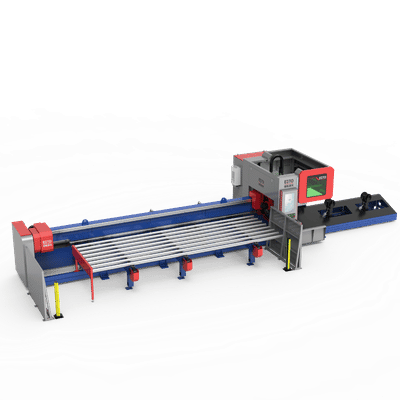
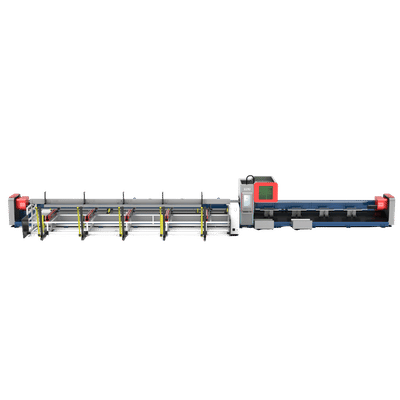
A tube laser cutting machine is a CNC-controlled system that uses a focused fiber laser beam to cut, notch, drill, and bevel metal pipes and tubes with high precision. Unlike traditional band saws or plasma cutting torches that produce rough edges requiring secondary finishing, a laser tube cutter delivers clean, burr-free cuts with positioning accuracy typically within ±0.03mm per meter of travel.
Core System & Precision
The core of the system is a fiber laser source — most commonly from manufacturers like Raycus or IPG — that generates a beam carried through optical fiber to a specialized cutting head. The tube is gripped by pneumatic chucks mounted on a rotating axis, allowing the CNC controller to coordinate tube rotation, longitudinal feed, and laser head movement simultaneously. This multi-axis coordination makes it possible to execute complex 3D cutting patterns — mitred joints, saddle cuts, slotted connections — in a single automated cycle without repositioning the workpiece.
Productivity & Efficiency
For fabrication shops transitioning from manual cutting methods, the productivity gains are substantial. A single tube laser cutter replaces what previously required a bandsaw, a drill press, a notching tool, and often a plasma table. Setup time drops from hours to minutes because the CNC software generates tool paths directly from CAD models. Material waste decreases because nesting algorithms optimize tube utilization, and the narrow laser kerf wastes far less material than a saw blade or plasma arc.
How Does a Pipe Laser Cutter Work?
The cutting process in a fiber laser pipe cutter breaks down into four stages: material loading, beam generation, CNC-controlled cutting, and part unloading. Understanding each stage helps you evaluate what level of automation your production volume actually requires.
Stage 01
Material Loading and Tube Clamping
Raw tubes are placed onto the machine’s material rack — manually on semi-auto models, or by a bundle feeder on fully automatic systems. A feeding mechanism pushes individual tubes into the chuck zone, where pneumatic jaws grip the tube concentrically. On machines with multiple chucks (the EETO FPC-HD uses 3 or 4 moveable chucks), floating supports stabilize long tubes during rotation to prevent vibration and maintain cut accuracy. In practice, the clamping step is where many quality issues originate — uneven clamping pressure causes tube deflection, which shows up as dimensional errors on the finished part. Good machines include auto-centering chuck systems that adapt jaw pressure based on tube wall thickness.
Stage 02
Fiber Laser Beam Generation
The fiber laser source converts electrical energy into a coherent light beam at approximately 1,070nm wavelength. This beam travels through a flexible optical fiber — there are no mirrors to align, which is one reason fiber lasers need far less maintenance than older CO2 laser systems. At the cutting head, a focusing lens concentrates the beam to a spot diameter of roughly 0.1mm. The energy density at this focal point exceeds 10^6 W/cm², enough to melt and vaporize steel almost instantly.
Stage 03
CNC-Controlled Multi-Axis Cutting
The CNC system (typically FSCUT for standard models or Beckhoff for 5-axis beam cutting) coordinates three simultaneous movements: the cutting head’s X/Y position, the tube’s rotation angle, and the tube’s longitudinal Z-axis feed. Assist gas — nitrogen for clean-edge stainless steel cuts, oxygen for faster carbon steel processing — flows coaxially through the cutting nozzle to blow molten material out of the kerf. Travel speeds reach 150 m/min on the EETO FPC-E series (1.5G acceleration), though actual cutting speed depends on material type and thickness. For reference, cutting 2mm stainless steel tube typically runs at 8-12 m/min at 3kW, while 10mm carbon steel drops to about 1.5-2.5 m/min at the same power level.
Stage 04
Part Separation and Unloading
After the cut program completes, finished parts drop onto a collection tray or conveyor. Automatic systems like the FPC-A feature a tilting unloading platform that sorts parts without operator intervention. The machine immediately feeds the next section of tube and continues the production cycle. With zero-waste chuck configurations available on the FPC-HD, the unusable scrap remnant at the tube end can be reduced to virtually zero — a meaningful saving when processing expensive stainless steel or alloy tube stock.
EETO FPC Series: Tube Laser Cutter Models Compared
EETO manufactures five distinct machine series to cover the full spectrum of tube and pipe laser cutting applications — from compact small-diameter cutting to heavy-duty structural steel fabrication. Each series is built on a common fiber laser platform with Raycus laser sources, BOCI cutting heads, and Yaskawa servo drives, but they differ in capacity, automation level, and target application.
Economy
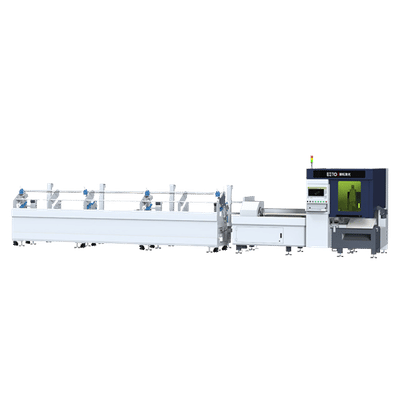
FPC-E Series
Designed for small-diameter tube cutting in workshops producing furniture frames, automotive exhaust components, fitness equipment, and sanitary fittings. The FPC-E keeps the footprint compact while delivering production-grade accuracy.
Laser Power1,500W – 3,000W
Max Diameter≤ 90mm
Tube Length6,000mm
Travel Speed150 m/min
Acceleration1.5G
Accuracy±0.03mm
Min Waste40mm
Cutting HeadBOCI BLT310T
CNC SystemFSCUT
ServoInovance
ShapesRound, Square, Rect, Oval
Semi-Auto
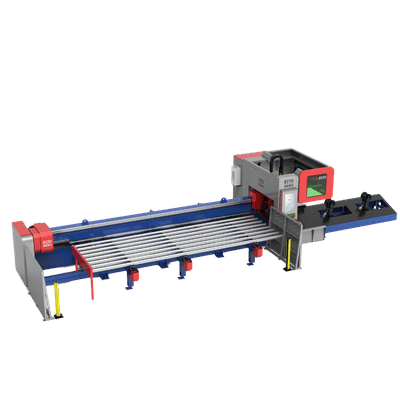
FPC-S Series
The mid-range workhorse for general fabrication shops. Semi-automatic loading with a 500kg material rack keeps tube feeding efficient without requiring a full automation investment. The side-mounted structure allows easy access for setup changes.
Laser Power1,000W – 6,000W
Diameter Range15 – 220mm (opt. 320mm)
Rack Load500kg
Chuck Load180kg
Travel Speed110 m/min
Rotary Speed80 r/min
Accuracy±0.03mm/m
Min Waste150mm
CNC SystemFSCUT
ServoYaskawa
ShapesRound, Sq, Tri, Rect, Oval, L, U
Full Auto
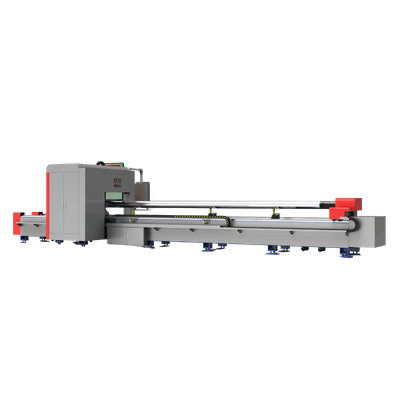
FPC-A Series
Fully automatic loading and unloading for high-volume production. Includes welding seam detection camera, auto-adjusting tube support, and inner surface cleaning system. The automatic tilting platform sorts finished parts without operator intervention.
Laser Power1,000W – 6,000W
Diameter Range15 – 220mm (opt. 360mm)
Rack Load500kg
Chuck Load180kg
Travel Speed110 m/min
Rotary Speed80 r/min
Accuracy±0.03mm/m
Min Waste150mm
Bevel CuttingYes
CNC SystemFSCUT
ServoYaskawa
ShapesRound, Sq, Tri, Rect, Oval, L, U
Heavy Duty
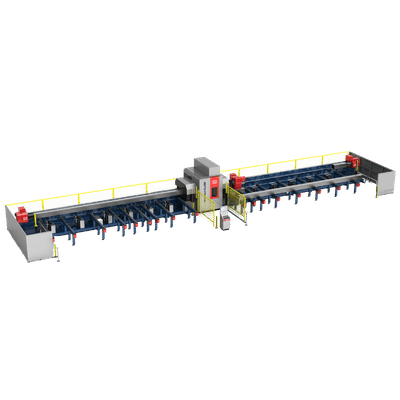
FPC-HD Series
Built for large-diameter pipe cutting in shipbuilding, oil and gas, and structural steel construction. The 3/4-chuck configuration with floating support handles heavy, long tubes with zero waste — critical when processing large-bore stainless steel pipe that costs over $50 per meter.
Max Diameter690mm
Standard Range20 – 520mm
Rack Load7,500kg (7.5 ton)
Chuck Load1,500kg
Chuck Config3 or 4 chucks
Min Waste0mm
Bevel CuttingYes
CNC SystemFSCUT 5000
ServoYaskawa
Inner CleaningDedicated system
ShapesRound, Sq, Tri, Rect, Oval, L, U
Structural
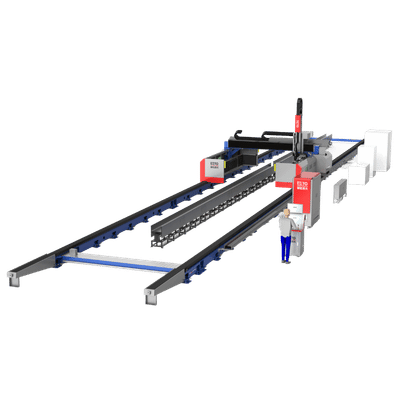
FHS Series — Beam & Profile Cutter
A 5-axis profile cutting system engineered specifically for H-beams, I-beams, channel steel, and angle steel used in steel structure fabrication. The Beckhoff automation controller and Bosch Rexroth motion components provide the precision needed for pre-welding bevel preparation on structural steel connections.
Cutting System5-axis
ProfilesH-beam, I-beam, Channel, Angle
Bevel CuttingYes (pre-weld prep)
ControllerBeckhoff Automation
MotionBosch Rexroth
ReducerWittenstein Alpha
ServoYaskawa EtherCAT
Cutting HeadBOCI BLT
SoftwareHypuct cutting system
Machine Body8mm welded steel
Laser SourceRaycus
Pipe Shapes & Materials: What Can a Metal Tube Laser Cutter Process?
Supported Tube and Profile Shapes
EETO pipe laser cutting machines handle seven standard tube profiles plus structural beam shapes. The pneumatic chuck jaws adjust automatically to grip different cross-sections securely, maintaining concentricity during high-speed rotation. Most shops run a mix of round and square tubes — the FSCUT CNC software stores profile-specific parameters so switching between shapes takes under a minute.
| Profile Shape | FPC-E | FPC-S / FPC-A | FPC-HD | FHS |
|---|---|---|---|---|
| Round Tube | ✓ | ✓ | ✓ | — |
| Square Tube | ✓ | ✓ | ✓ | — |
| Rectangular Tube | ✓ | ✓ | ✓ | — |
| Triangular Tube | — | ✓ | ✓ | — |
| Oval Tube | ✓ | ✓ | ✓ | — |
| L-Shape (Angle) | — | ✓ | ✓ | ✓ |
| U-Shape (Channel) | — | ✓ | ✓ | ✓ |
| H-Beam / I-Beam | — | — | — | ✓ |
Material Cutting Capabilities
Fiber laser tube cutters excel on ferrous and non-ferrous metals. The table below shows maximum wall thickness capacity at 6kW laser power — actual throughput depends on your specific power configuration and required edge quality.
| Material | Max Wall Thickness (6kW) | Assist Gas | Edge Quality Notes |
|---|---|---|---|
| Carbon Steel | 24mm | Oxygen / Air | Oxide layer on cut edge with O₂; cleaner with air assist |
| Stainless Steel | 16mm | Nitrogen | Bright, oxide-free edge; ideal for food/pharma applications |
| Galvanized Steel | 16mm | Nitrogen / Air | Minimal zinc coating damage; slight discoloration near kerf |
| Silicon Steel | 16mm | Nitrogen | Used in transformer core laminations |
| Aluminum Alloy | 10mm (typical) | Nitrogen | Higher reflectivity requires proper beam focus adjustment |
| Copper / Brass | 6mm (typical) | Nitrogen | High reflectivity — needs higher power density |
Practical Insight
One practical detail that specification sheets rarely mention: when cutting stainless steel tubes for food-grade or pharmaceutical applications, nitrogen gas purity matters significantly. You need at least 99.95% purity to achieve a truly oxide-free bright edge. Many shops learn this the hard way when their “stainless steel” cuts come out with a faint yellow tint — the cause is almost always inadequate gas purity, not a machine issue.
Key Applications and Industries for Tube Laser Cutting
Tube laser cutting technology serves virtually every metal fabrication sector where precision pipe and tube processing adds value. The common thread across all applications is replacing multiple manual operations — sawing, drilling, notching, deburring — with a single automated process that delivers consistent quality at production speed.
Steel Structure & Construction
Connection node cutting, bevel preparation for welded joints, notching for truss assemblies. The FHS series handles H-beams and I-beams for structural steel fabrication.
Automotive & Exhaust Systems
Exhaust manifold tube cutting, chassis frame components, roll cage tube processing. High-speed cutting on thin-wall tubes under 3mm.
Furniture & Shelving
Chair frames, desk legs, retail display fixtures, warehouse shelving components. Complex joint patterns that would require multiple setups on conventional machines.
Fitness Equipment
Gym machine frames, weight racks, exercise bike structures. Aesthetic cut quality matters here since tube joints are often visible in the finished product.
Oil & Gas / Shipbuilding
Large-diameter pipe processing for pipeline infrastructure, vessel construction, and offshore structures. FPC-HD handles pipes up to 690mm diameter at 7.5-ton material weight.
HVAC & Ductwork
Rectangular and round duct connections, transition pieces, flanged joints. Galvanized steel tube processing with minimal coating damage.
Agricultural Equipment
Implement frames, trailer structures, sprayer booms. Outdoor equipment demands consistent weld-prep quality for corrosion-resistant joint finishing.
Medical & Sanitary
Stainless steel tubing for hospital equipment, pharmaceutical piping, food processing machinery. Nitrogen-assisted cutting delivers the oxide-free finish these applications require.
Technical Specifications for EETO Fiber Laser Tube Cutting Machines
The specifications below are sourced directly from EETO product data sheets and the eetolaser.com product pages. Power-dependent cutting thickness values correspond to 6kW fiber laser configuration; lower power models will have proportionally reduced thickness capacity.
| Specification | FPC-E | FPC-S | FPC-A | FPC-HD | FHS |
|---|---|---|---|---|---|
| Laser Power | 1.5 – 3kW | 1 – 6kW | 1 – 6kW | Up to 6kW+ | Raycus |
| Max Pipe Diameter | 90mm | 220mm (opt. 320mm) | 220mm (opt. 360mm) | 690mm | N/A (profiles) |
| Tube Loading Length | 6,000mm | — | 6,000mm | — | — |
| Max Rack Load | — | 500kg | 500kg | 7,500kg | — |
| Max Chuck Load | — | 180kg | 180kg | 1,500kg | — |
| Positioning Accuracy | ±0.03mm | ±0.03mm/m | ±0.03mm/m | — | — |
| Max Travel Speed | 150 m/min | 110 m/min | 110 m/min | — | — |
| Acceleration | 1.5G | 1.0G | 1.0G | — | — |
| Rotary Speed | — | 80 r/min | 80 r/min | — | — |
| Min Waste Length | 40mm | 150mm | 150mm | 0mm | — |
| Chuck Config | Standard | Standard | Standard | 3 or 4 chucks | — |
| Bevel Cutting | — | — | Yes | Yes | Yes (5-axis) |
| Loading System | Semi/Full Auto | Semi-Auto | Full Auto | Semi-Auto | — |
| Laser Source | Raycus CE | Raycus | Raycus | Raycus | Raycus |
| Cutting Head | BOCI BLT310T | BOCI BLT | BOCI BLT | BOCI BLT | BOCI BLT |
| CNC System | FSCUT | FSCUT | FSCUT | FSCUT 5000 | Beckhoff |
| Servo Motors | Inovance | Yaskawa | Yaskawa | Yaskawa | Yaskawa EtherCAT |
| Linear Guides | CSK | — | — | — | Bosch Rexroth |
| Cutting Axis | 3-axis | 3-axis | 3-axis | 3-axis | 5-axis |
Material Cutting Thickness by Laser Power
| Material | 1.5kW | 3kW | 6kW |
|---|---|---|---|
| Carbon Steel | 8mm | 14mm | 24mm |
| Stainless Steel | 5mm | 8mm | 16mm |
| Galvanized Steel | 5mm | 8mm | 16mm |
| Aluminum | 3mm | 6mm | 10mm |
Source: EETO product data sheets (eetolaser.com). Cutting thickness values represent maximum capacity; optimal cutting speed and edge quality vary by specific material grade and tube geometry. Contact EETO technical support for material-specific cutting parameter recommendations.
Tube Laser Cutting in Action: Project References
These project references illustrate how different industries apply EETO tube laser cutting machines to solve specific production challenges. Each case describes a real application category — for specific project details and performance data tailored to your application, contact our technical team.
Heavy Industry
Steel Structure Fabrication — FPC-HD for Pre-Welding Prep
Challenge
A structural steel workshop processing large-bore rectangular tubes (300×200mm, 12mm wall) needed bevel cuts. Plasma tables required manual grinding (6-8 mins/joint), creating bottlenecks.
Solution
EETO FPC-HD with 3-chuck config and bevel cutting head. 7,500kg rack for full-length tubes; zero-waste chuck eliminated 150-200mm scrap per end.
Consumer Products
Fitness Equipment Manufacturing — FPC-E for Frame Production
Challenge
Cutting round/oval tubes (25-76mm) for gym frames. Manual drilling caused ±1.5mm hole variation, leading to assembly fit-up problems.
Solution
EETO FPC-E (3,000W) with auto loading. ±0.03mm accuracy and 150 m/min speed allowed integrated cutting and drilling in one program.
Automotive
Automotive Exhaust Components — FPC-A for High-Volume Production
Challenge
Processing stainless steel tubes at 500+ parts/shift. Old bandsaw/lathe process only achieved 320 parts with 2 operators and inconsistent quality.
Solution
FPC-A fully auto loading + weld seam detection camera. Inner surface cleaning system removed debris essential for downstream welding.
Tube Laser Cutting Machine Price Guide: Key Cost Factors
Price is an important consideration; tube laser cutting machine pricing depends on several factors, including level of automation, laser power, pipe diameter capacity, and choices of component brands. This broad market look at price brackets provides a general guidelines, actual prices depend on your configuration, project quantity, and delivery terms. For a customized quote, please contact us.
Entry Level
$30,000 – $80,000
Small diameter tube cutters (90mm range) with 1.5-3kW fiber laser. Suitable for small diameter furniture, fitness, precision and fabrication shops processing thin-wall tube (less than 6mm wall thickness). Semi-automatic loading.
EETO FPC-E series falls in this range.
Mid Range
$80,000 – $200,000
Mid-range diameter capacity (up to 320-360mm) with 3-6kW laser, fully automatic loading and unloading, bevel cutting ability. General fabrication, industrial HVAC, automotive, construction tube processing.
EETO FPC-S and FPC-A range configurations below.
Heavy Duty
$200,000+
Heavy-duty capacity (up to 690mm diameter) multi-chuck configurations, with 7.5-Ton material handling capacity, zero-waste operation. Marine, oil-gas, shipyard, large structural steelwork. 5-axis beam cutting system (FHS) for good measure.
EETO FPC-HD and FHS series.
Key Factors That Affect Your Total Cost
An initial “bookmark” price is only one factor affecting the overall expenditure; here are parameters experienced laser buyers look at:
| Cost Factor | Impact on Price | Practical Consideration |
|---|---|---|
| Laser Power (kW) | Each kW step-up adds ~$5,000-15,000 | Buy for your heaviest regular material, not occasional thick-wall jobs |
| Laser Source Brand | IPG costs more than Raycus | Raycus CE-series delivers reliable performance for most industrial applications |
| Loading Automation | Full auto adds $15,000-40,000 vs semi-auto | ROI positive above ~300 tubes/shift |
| Chuck Configuration | 3/4-chuck adds $10,000-25,000 | Pays back on expensive material (zero-waste operation) |
| Bevel Cutting Head | Adds $8,000-20,000 | Essential for structural steel welding prep; skip if you only need straight cuts |
| Dust Extraction | $3,000-8,000 for integrated system | Required for enclosed workshop environments |
| Consumables (annual) | $2,000-5,000/year | Protective lenses, nozzles, ceramic rings — stock locally for minimal downtime |
When quoting from different manufacturers, ensure you’re comparing apples to apples. Another “3kW tube laser cutter” may be fully loaded with optional advanced features like bevel cutting, auto loading, dust extraction, while another vendor will include only the simplest, bare-bones, base machine at a much higher price. Ask for a detailed, itemized quote.
Request Detailed Quotation
After-Sales Support and Global Service Network
For an international buyer of a tube laser cutting machine, a company’s post-sales support capability significantly affects the actual value of your new investment. A machine that awaits service or spare parts for weeks in the back of the warehouse with an uninterested manufacturer ability to deliver spare parts or technical solutions negates the initial capital savings.
Direct Technical Support
EETO provides dedicated after-sales contact that is not the same as its sales line, staffed by technicians specializing in troubleshooting, parameter adjustment, and warranty service scheduling.
With remote video diagnosis capabilities, the concern can often be resolved without requiring the technician to arrive on-site with the customer’s approval. Watch the laser head live, review the error code histories from the FSCUT CNC system.
With remote video diagnosis capabilities, the concern can often be resolved without requiring the technician to arrive on-site with the customer’s approval. Watch the laser head live, review the error code histories from the FSCUT CNC system.
Technical Hotline
+86-13397135722
24/7 Expert Line
Distributor Training
EETO considers its regional dealers as long-term partners, not just points of sale. EETO provides dealers with product training, technical and engineering materials, marketing support so the dealer can deliver first-line service in the local market, handle routine repairs, and purchase replacement component parts at a reduced price (which in turn reduces the customer’s TCO).
Spare Parts & Consumables
Among the most important wear parts on a tube laser cutter are protective lenses, nozzles, and ceramic rings, and chuck jaw inserts. The company encourages its distributors to stock basic expendable parts for operational downtime minimization. For the laser source, head assembly and servo drives, the company has a laser shop in-house dedicated to test and repair.
Tube Laser Cutter Selector
Answer 4 questions to find the ideal EETO machine for your production line.
0%
Match Quality
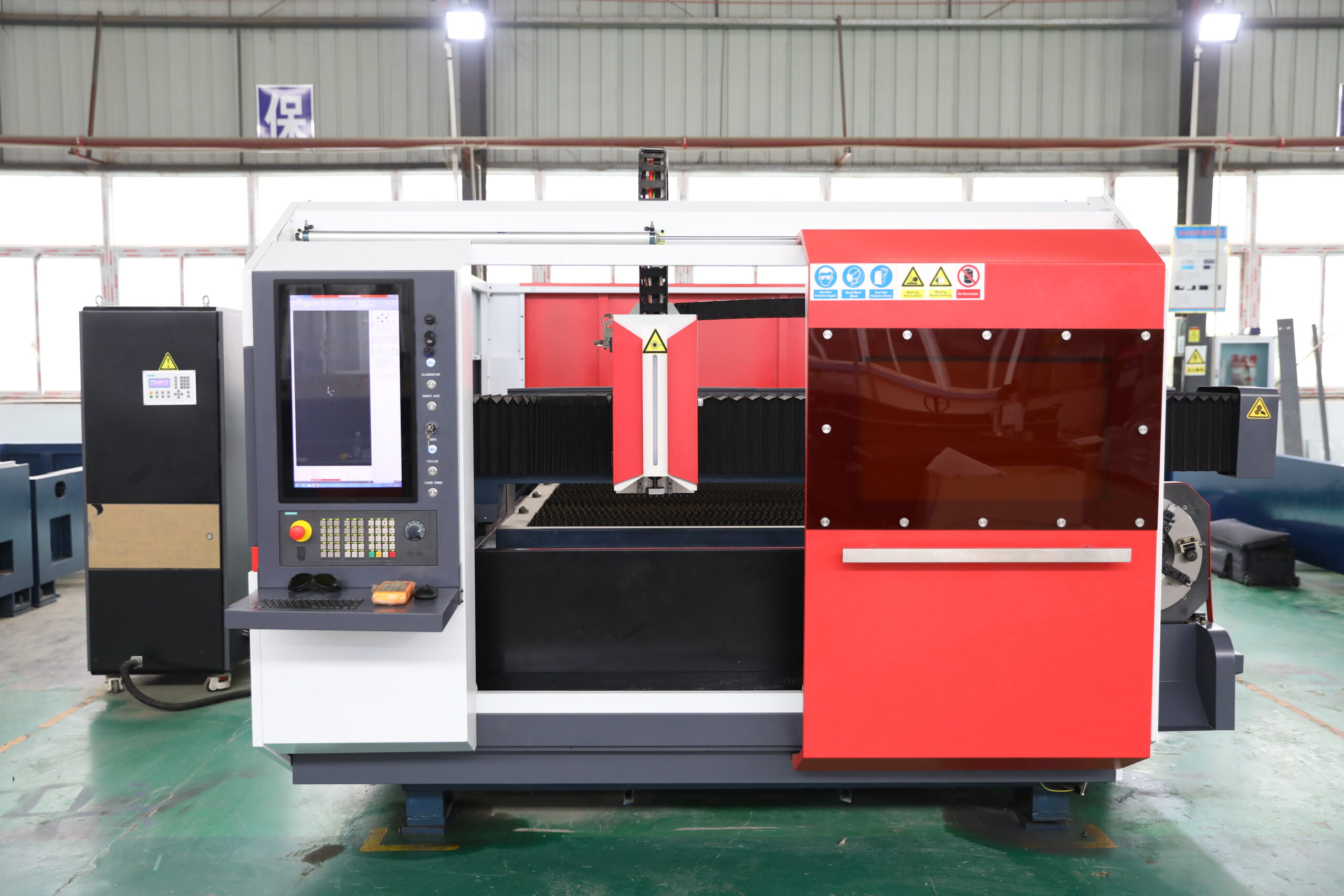
Manufacturing Excellence & Global Presence
From our state-of-the-art manufacturing facilities to international exhibitions and strategic partnerships, EETO Laser is dedicated to delivering world-class pipe cutting solutions globally.



×
![Full View]()
Frequently Asked Questions About Pipe & Tube Laser Cutters
What is a tube laser cutting machine and how does it work?
A tube laser cutting machine is designed to cut notches and profile metal tubes and pipes by means of a highly focused fiber laser beam. The tube can be loaded in a horizontal fixture and moved into place and clamped by pneumatic chucks; the laser head can be moved in various axes by the CNC while the tube rotates. The fiber laser source delivers a high energy, narrow width laser beam though optical fiber to a cutting head. The laser is focused down to a small spot of approximately 0.1mm diameter. Material is then melted and vaporized along the desired cutting path. Nitrogen or oxygen gas is bled through the cutting head to clear molten material from the cut. Modern CNC machines are capable of cutting out round, square, rectangular, triangular and custom profile tubes in one operation. Setup typically takes minutes rather than hours since the software imports geometry straight from CAD files and generates cutting paths automatically, so a single operator can manage the entire production run from raw tube to finished part with minimal manual intervention required between jobs.
What materials can a tube laser cutter process?
Most of the popular general fabrication metals can be processed with a fiber laser tube cutter, carbon steels can be cut up 24mm wall thickness, stainless up to 16mm, galvanized 16mm, silicon steel 16mm, Aluminum alloys,etc. A 6kW machine will cut all of those standard materials at a cost effective rate of production. If you need to cut copper or brass, most suppliers will be able to help with higher power settings for the reflectivity nature of those materials. The general rule is in having the laser power appropriate to the work you do on a regular basis, the most general type fabrication is certainly with a 3kW laser tube cutter.
What pipe shapes can be cut with a laser tube cutting machine?
Most contemporary tube laser cutters handle 7+ profile shapes: round, square, rectangular, oval, triangular, channel, L-shaped. Specialized beam cutting machines (EETO FHS series) add H-beam, I-beam, channel steel, and angle steel for structural use.
What is the maximum pipe diameter and wall thickness a tube laser can cut?
Performance varying with series: Economy series (FPC-E) maximum tube size is 90mm diameter. FPC-S, FPC-A, FPC has maximum diameter 220mm and can be extended to maximum 360mm diameter. FPC-HD has maximum pipe diameter 690mm and with maximum chuck load 1,500Kg. Thickness maximum wall depends on laser power as follows: carbon steel maximum wall thickness is 24mm, stainless steel maximum wall thickness is 16mm with a 6KW fiber laser.
What is the difference between a tube laser cutter and traditional pipe cutting methods?
Conventional cutting methods- bandsaws, plasma torches, and manual oxy-fuel cutting-are relatively slow, need finishing on cut edges, and cut wider kerf widths with large HAZ’s. Fiber laser tube cutter offers 0.03mm positional accuracy, hence almost zero kerf wastage, reduced heat distortion, and finished cut edges that usually require no deburring. CNC tube laser substantially reduces cycle times, say, by 60-80%, compared to traditional cutting, notching, hole piercing, and beveling method, and material wastage when CNC nesting software optimizes the tubes to reduce excess wastage.
Can a tube laser cut angle iron and structural profiles?
Yes, however this will require a special machine designed for open profiles, a typical tube laser cutter will cut closed profiles (round, square, and rectangular). However for open profiles (angle iron, channel steel, H-beam, I-beam), you will need a 5 axis profile cutting machine such as the EETO FHS series with Beckhoff automation controller and Bosch Rexroth motion parts which lifts around web and flange intersections.
How much does a tube laser cutting machine cost?
Costs vary considerably depending on laser power, pipe diameter capacity, automation level, and reputation. Entry machines for small-diameter pipes (under 90mm) with 1.5-3kW power starts at $30,000-$80,000. Mid-range automated loading machines with 3-6kW of power, and capacity to 360mm exists between $80,000-$200,000. Heavy-duty systems for large pipes (over 500mm) can cost more than $250,000. Major price factors are laser source brand, loading automation, bevel cutting ability, and chuck configuration.
What laser power do I need for my tube cutting application?
A 1,500W fiber laser has enough power to cut thin-wall pipes (under 6mm) from carbon steel (most shop needs). The 3,000W range feeds most general fabrication – carbon steel (up to 12mm) and stainless-steel (up to 8mm). Go 6,000W for locations working substantial thick-wall pipe (over 12mm), or for extremely high-volume high-speed cutting. Cost-effectiveness is balanced with 3kW for most fabrication shops. More power is only necessary for heavier material or super high-volume output.
What is the positioning accuracy of CNC tube laser cutters?
Expect 0.03mm per meter of travel on industrial CNC tube lasers. EETO FPC series uses Yaskawa servos with high-resolution encoders and FSCUT controls. Cutting accuracy lands around 0.1mm once you factor in beam focus and gas pressure variables.
How do I choose between automatic and semi-automatic tube laser loading?
Semi-automatic loading allows one operator to set packages of raw material, semi-automated feeding (under 200 tubes per shift). Fully-automatic loading handles whole workflow with little human input, justified for production over 300-400 tubes per shift or higher labor-cost environments. Automatic operation reduces handling time and risk of damage, and enables consistent quality throughout long series production.